
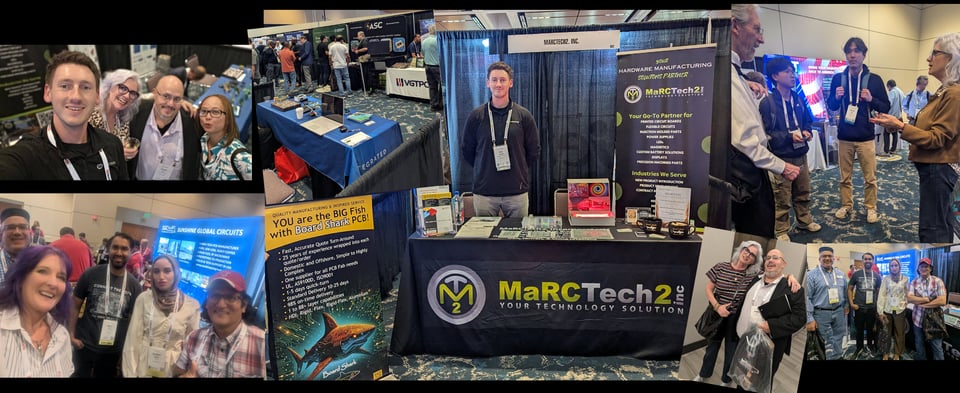
Jennifer, Krystal, and Nick's biggest takeaway from PCB West 2026 is that the industry is moving decisively toward earlier, tighter collaboration between design, fabrication, assembly, and sourcing.
The conversations MaRCTech2 is positioned to lead, before a layout is frozen or a quote is requested, are becoming more commercially and technically valuable.
“Retire the respin” was the central message
The conference theme was not merely about avoiding layout errors. It reflects a broader requirement to bring fabricators, assemblers, material suppliers, and manufacturing partners into projects early—when stackup, materials, tolerances, test strategy, component availability, and reliability tradeoffs can still be changed affordably.
For Jennifer, Krystal, and Nick, that means MaRCTech2 is a front-end technical resource, not only as a source for a manufacturer or a quote.
“Bring us in while the board is still a design decision, not after it becomes a production problem.”
This directly supports Board Shark, a division of NCAB, and other principal partners with capabilities that matter most when customers have difficult requirements, not commodity requirements.
PCB design, fabrication, and assembly are converging
PCB West’s 2026 program covered:
- high-speed design
- signal integrity
- HD
- flexible circuits
- materials
- advanced assembly
- testing
- and supply-chain strategy,
an indication that these can no longer be treated as isolated disciplines.
The practical implication is that Jennifer, Krystal, and Nick will be listening for, and serving, cross-functional issues such as:
- Can the selected laminate, copper weight, surface finish, and stackup support both electrical performance and manufacturability?
- Does a fine-pitch device, BGA, HDI feature, or flex-rigid requirement create assembly or inspection risk?
- Have the fabricator and assembler reviewed the design before release?
- Are documentation, tolerances, test expectations, and supply assumptions clear across engineering and purchasing?
Understanding this is particularly useful because it turns a product conversation into risk reduction for engineering, procurement, and operations.
High-reliability and domestic capability remain differentiators
The team at MaRCTech2 went to PCB West 2026 specifically to discuss high-reliability requirements, unusual capability questions, domestic manufacturing perspectives, and programs where performance, responsiveness, and supply-chain visibility matter.
Jennifer, Nick, and Krystal returned with a deeper understanding of critical issues:
|
Customer signal |
Focus area |
|
High consequence of failure |
Reliability requirements, materials, traceability, test, and engineering support |
|
Fast-changing program or uncertain demand |
Responsiveness, communication, engineering access, and supply visibility |
|
Aerospace, defense, medical, industrial, or harsh environment |
Controlled processes, long-term support, documentation, and domestic capacity |
|
Advanced design features |
Early DFM/DFT review, stackup/material decisions, fabrication limits, and assembly alignment |
|
Frustration with offshore uncertainty |
Total project risk, speed of problem resolution, visibility, and continuity… not only the piece price |
The point is: domestic fabrication does not fit every job.
The MaRCTech2 team helps customers recognize when the lowest quoted board cost can be outweighed by schedule exposure, rework, quality risk, or limited engineering access.
AI is real - but practical value matters
PCB West’s future-design discussion centered on AI’s realistic role in PCB design, along with interposer boards, higher-speed/higher-current demands, and optical interconnects. The event encouraged the industry to look beyond generic AI hype to where AI can genuinely improve design work and where human engineering judgment remains essential.
The reminder the MaRCTech2 team took away from the event is to be curious, not promotional:
- Be interested in where AI-assisted design or automation is creating new speed, documentation, or library-management expectations.
- We will be watching for designs that become more complex faster than their validation and manufacturability processes mature.
- Reinforce that automation does not eliminate the need for manufacturability review, material expertise, fabrication knowledge, and accountable human communication.
In other words,
AI may accelerate decisions,
but it can also accelerate a flawed decision into production if the right people are not involved early.
The follow-up opportunity
PCB West brings together more than 2,000 designers, engineers, fabricators, and assemblers, plus more than 100 exhibiting companies, for a four-day technical conference, with the exhibition compressed into a single day. That created many brief but potentially valuable conversations.
Bottom line
The biggest takeaway is not one technology or one exhibitor. It is that MaRCTech2’s value proposition is increasingly aligned with where the PCB industry is headed:
“connect the right manufacturing expertise to a design early enough to prevent expensive surprises.”
Jennifer, Krystal, and Nick want to apply what they learned at PCB West 2026 to help you ask smarter questions before release, align engineering with purchasing and manufacturing, and match complex or high-risk programs to the right domestic and specialty resources.
Do you have a question or project?
Contact us here: https://www.marctech2.com/contact-us