
A friendly guide for curious humans - If you’ve ever wondered why a phone battery lasts so long, or why electric cars don’t weigh as much as a T-rex, it all comes down to what’s inside the battery. Two big players today are lithium-ion and sodium-ion batteries. They work in a similar way, but they’re built from very different “ingredients” - and those differences matter.
- What’s actually moving inside these batteries?
Think of batteries as tiny gyms where ions run back and forth during charging and discharging.
-
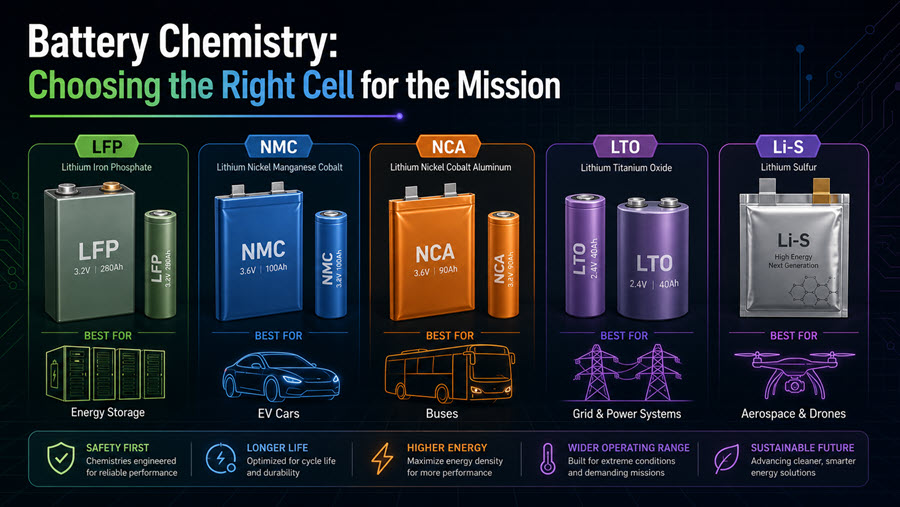
- Lithium-ion batteries use lithium ions.
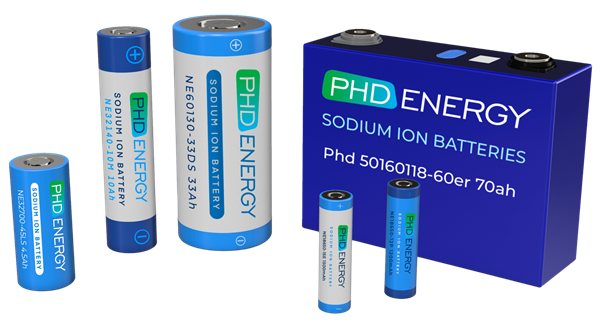
- Sodium-ion batteries use sodium ions.
Ah-ha moment: Sodium is literally the stuff in table salt. So yes, one day your home battery backup might be powered by something related to your french fries.
- Energy Density: How much “oomph” can it store?
Lithium is light and super energetic. Sodium is heavier and a little more tired-looking.
-
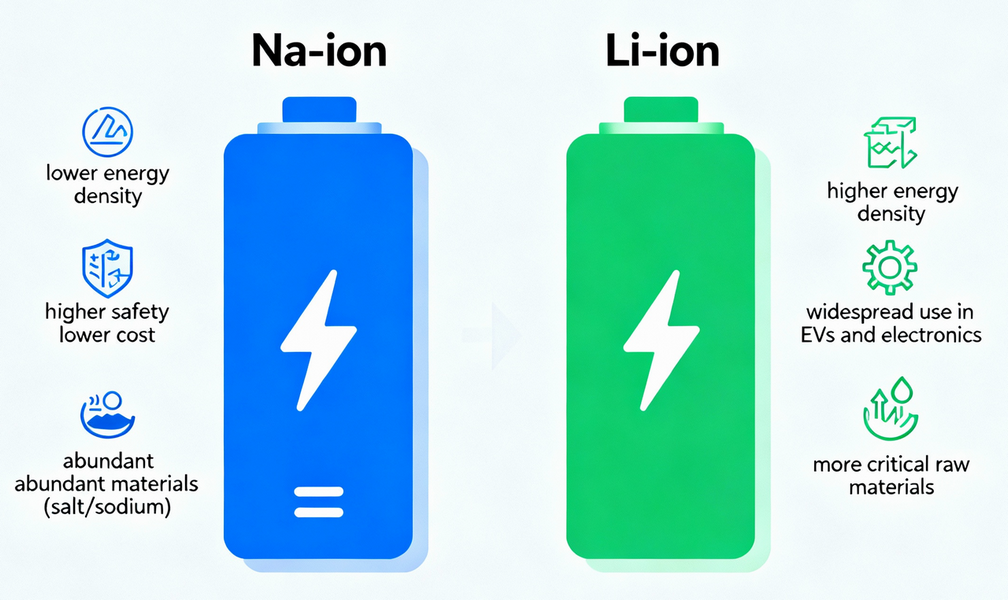
- Lithium-ion: High energy density. That’s why phones and long-range EVs love it.
- Sodium-ion: About 30% less energy per pound. Still good — but not “fit in your jeans pocket” good.
Myth: Sodium‑ion can “match” lithium‑ion on energy density today. Projections suggest sodium‑ion could improve, but the current commercial sodium‑ion is still typically 30%+ lower in energy density.
Ah-ha moment: Sodium-ion works great when size doesn’t matter. Think garages, sheds, grid energy storage… big spaces that don’t care about extra “battery belly.”
- Performance & Lifetime: Which lasts longer?
Lithium-ion batteries have been tested for years in everything from earbuds to Teslas. Sodium-ion is the new kid - but showing real promise.
-
- Sodium batteries are already hitting thousands of charge cycles, and some claim 10,000+ in the lab.
- Efficiency is high for both - mid-90% range.
BUT - Lithium‑ion cycle life varies widely by chemistry (e.g., LFP can reach 2,000–5,000+ cycles), so any blanket claim that “sodium‑ion lasts longer than lithium‑ion” might be too broad; it is accurate only versus certain Li‑ion chemistries or at specific operating conditions.
Ah-ha moment: Sodium-ion is catching up fast, even though it’s newer. It’s like watching a sophomore suddenly outrun the seniors.
- Charging & Temperature: Who handles the cold better?
This is where sodium-ion surprises everyone.
-
- Sodium-ion tends to charge better at low temperatures.
- Lithium-ion can get fussy when it’s super cold or super-hot.
Ah-ha moment: Sodium-ion might become the favorite in states where winter feels like a freezer slap.
- Safety: Who behaves better under stress?
Lithium-ion batteries can sometimes go into thermal runaway (the scary “fire risk” thing you’ve heard about).
Sodium-ion batteries? Sodium‑ion chemistries under development generally show better thermal stability and lower risk of flammable organic electrolyte run‑away than many conventional Lithium‑ion cells, so they are often described as safer for large stationary systems.
-
-
- Fewer overheating problems.
- Less chance of fire.
-
Going deeper: It is important to note that Lithium‑ion fires are still statistically rare relative to the number of deployed packs. Some folks will say that lithium‑ion is “unsafe in general,” but this overstates the risk. Safety is more about system design, BMS, and use‑case than chemistry alone.
Ah-ha moment: Sodium-ion is like the battery that doesn’t freak out during exams.
- Cost & Materials: Which is easier on the planet (and your wallet)?
-
- Lithium requires mining in specific places, and some chemistries use pricey or controversial metals like cobalt and nickel.
- Sodium is everywhere. Oceans. Dirt. Even your ramen seasoning.
Because sodium is so abundant, sodium-ion batteries could become much cheaper as production increases.
Ah-ha moment: Sodium-ion is basically the “budget-friendly, everywhere-on-Earth” option.
- What are each of them best for?
|
Use Case |
Lithium-Ion |
Sodium-Ion |
|
Phones |
Yes |
Definitely not |
|
Laptops |
Yes |
Too bulky |
|
Long-range EVs |
Yes |
Not yet |
|
Home backup |
Works well |
Getting VERY popular |
|
Grid storage |
Works |
Possibly the future |
|
Budget EVs |
Maybe |
Yes — coming soon |
Pause to consider: Sodium‑ion is not yet considered a near‑term “replacement” for lithium‑ion in all EV applications. The current consensus is that sodium‑ion will complement, not fully replace, lithium‑ion for the foreseeable future.
Ah-ha moment: Lithium wins where size and weight matter. Sodium wins where cost, safety, and space matter.
- What should buyers pay attention to?
If you’re considering sodium-ion:
-
- Energy density (will it fit the space you have?)
- Warranty (since it’s still new)
- Safety certifications
- Installation options (many sodium systems can go indoors without special fire gear)
For now, your phone and laptop aren’t switching to sodium. But a home backup battery? Your power utility? Your future budget-friendly car? Very possible.
The Big Picture
Lithium‑ion is a mature, high‑energy technology that will remain central to batteries for years to come, especially in mobile and space‑constrained applications. Sodium‑ion is a promising, complementary technology that trades some energy density for potential gains in cost, safety margin, and resource availability, making it particularly compelling for stationary and large‑scale storage. Rather than replacing lithium‑ion outright, sodium‑ion is likely to expand the range of battery options and help the industry match the right chemistry to the right job.
Sodium‑ion batteries are not necessarily “environmentally harmless.” Cathode, anode, and electrolyte materials still carry environmental and manufacturing footprints similar to those of lithium-ion, just with different magnitudes.
Big picture: Lithium is ideal for portable, high-energy devices; sodium is emerging as a safer, more affordable solution for large-scale energy storage. They’re not competitors so much as partners built for different missions.
Ah-ha moment: We’re not replacing lithium-ion - we’re adding a whole new option that solves new problems.