


There is always another headline competing for your attention.
A technology company faces turmoil.
A stock takes a sharp turn.
Someone declares that everything is about to change.
For engineering, purchasing, and manufacturing teams,
the useful question is not, “How big is this story?”
It is, “Does this change a decision we need to make?”
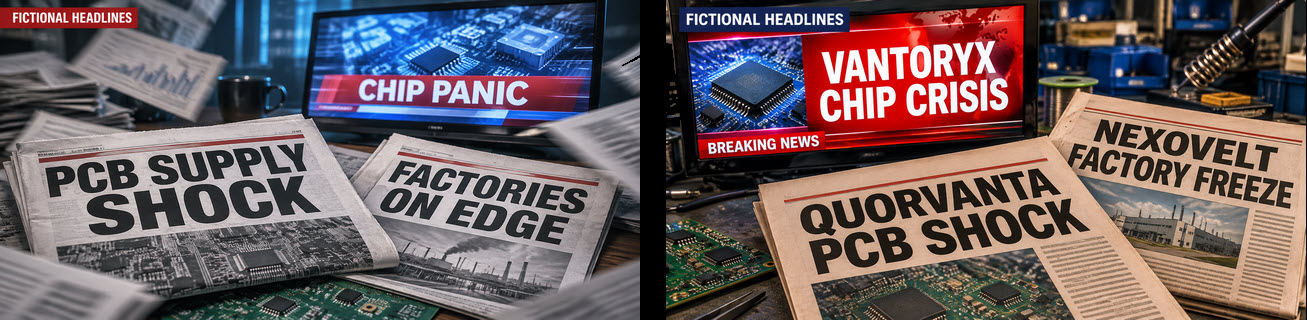
Those questions are not the same. Knowing the difference helps keep attention where it belongs: on the work that moves your program forward.
Separate attention from action
Being informed matters. But being informed does not mean treating every development as a reason to change direction.
A headline can deserve a closer look without deserving a new purchasing strategy. A concern can belong on a watch list without becoming an urgent meeting. An important development for investors may have little bearing on the component, material, or manufacturing partner your team needs.
The goal is not to tune out the news. It is to put the news in its proper place.
Before adjusting a plan, establish a connection between what happened and what your program needs.
Put the news through a practical filter
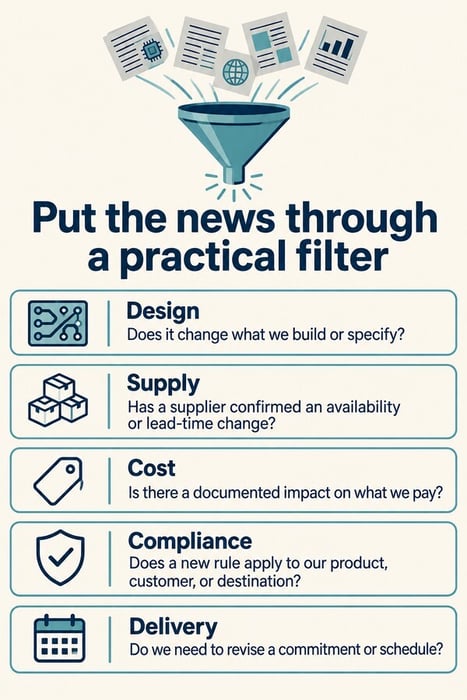 When a news story raises questions, start with five of your own:
- Design: Does this change a specification, component choice, qualification requirement, or product roadmap?
- Supply: Has a supplier confirmed a change in availability, capacity, allocation, or lead time?
- Cost: Is there a documented effect on the parts, materials, or services your program purchases?
- Compliance: Has an applicable requirement changed, and does it affect your product, customer, or destination?
- Delivery: Is there a specific reason to revise a commitment or project schedule?
These questions are not predictions. They are a way to determine whether a broad story has become a practical issue.
If the answers are unclear, the next step is verification—not an automatic change in direction.
Ask what changed, not just what might happen
Consider the difference between these two statements:
“There could be supply-chain disruption.”
“Our supplier has extended the quoted lead time for this part, and it affects our next production build.”
The first describes a possibility. The second identifies something a team can evaluate and act on.
Useful information should help answer:
- What changed?
- Which products or programs are affected?
- Who confirmed it?
- When does it take effect?
- What options do we have?
Not every question will have an immediate answer. That is a reason to identify what remains unknown, rather than fill the gaps with assumptions.
A measured response might be to check an open order, confirm a quotation, review an alternative, or simply set a date to reassess. The action should match the evidence.
Keep the program, NOT the news cycle, at the center
At MaRCTech2, our focus is helping customers address engineering, quality, operational, and supply-chain needs through the manufacturers we represent. That is the lens through which industry developments should earn their relevance.
Does the information help a customer evaluate a manufacturing option?
… clarify a capability?
… ask a better technical question?
… understand a delivery concern?
If it does, it deserves attention.
If it does not, there is no obligation to turn it into an urgent issue simply because it is receiving widespread coverage.
The customer’s program remains the priority. The headline is context.
Staying focused is not standing still
There is an important distinction between refusing to react and being ready to respond.
Refusing to react means dismissing a development before understanding it. Being ready to respond means watching for a specific consequence, knowing who can verify it, and deciding what would justify action.
A useful internal statement is:
“We are monitoring this development. Here is the potential connection to our program, here is what we have confirmed, and here is what would cause us to change our plan.”
That is neither complacency nor alarm. It is a clear basis for making decisions.
Give attention to what changes the decision
Engineering, purchasing, and manufacturing teams do not need every headline translated into a warning. They need help distinguishing what is interesting from what is consequential.
Sometimes the right response is to act quickly.
Sometimes it is to ask a supplier one more question.
And sometimes it is to keep moving with a sound plan.
At MaRCTech2, we believe industry news earns its place in the conversation when it helps customers make a better decision.
Our role is not to make every story feel urgent. It is to help keep the right questions, and the customer’s program ---- at the center.